Why Delhi Looked to the Skies
Every November, as air pollution peaks, Delhi turns into a gas chamber — smog blankets the skyline, AQI crosses 400, and hospitals report surges in respiratory distress. Traditional responses like water sprinkling, anti-smog guns, and traffic restrictions only scratch the surface.
So, in October 2025, Delhi took an unprecedented step: it decided to make it rain artificially — an experiment driven by IIT-Kanpur scientists and supported by the Delhi government.
The idea: a well-timed drizzle could wash away airborne pollutants (PM2.5, PM10) and provide at least a temporary clean-air window.
(Also read: What measures are being taken to improve Delhi’s air quality?)
What Exactly Is Artificial Rain?
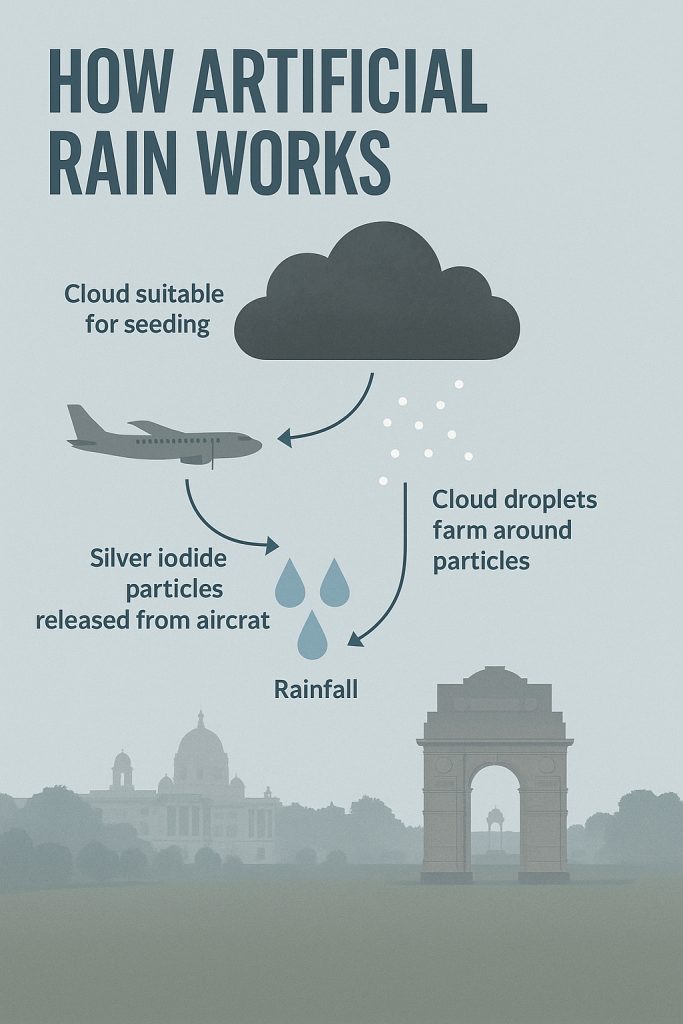
Artificial rain — or cloud seeding — is a weather-modification technique. It works by injecting special particles like silver iodide, sodium chloride, or potassium chloride into suitable clouds to stimulate precipitation.
The concept isn’t new. It dates back to 1946, when Vincent J. Schaefer of General Electric created the first artificial snow by releasing dry ice into a supercooled cloud. His colleague Bernard Vonnegut later discovered that silver iodide could mimic ice crystals, making cloud seeding more efficient.
The Delhi Experiment — What Happened
- Date: 28 October 2025
- Location: A 25-nautical-mile corridor covering Khekra → Burari/Narela → Karol Bagh → Mayur Vihar
- Aircraft Used: Cessna 206H (VT-IIT) operated by IIT-Kanpur, approved by DGCA
- Seeding Agents: Silver Iodide (AgI) + Sodium Chloride (NaCl) flares
- Sorties: Two flights (~18 minutes each) at 4,000–6,000 ft altitude
- Objective: Induce light rainfall to reduce pollution
Despite the preparation, no measurable rainfall occurred in Delhi that day. Some drizzle was recorded in Noida and Greater Noida, but it was too weak to affect AQI levels meaningfully.
💰 How Much Did It Cost?
The Delhi government allocated ₹3.21 crore for five planned trials (around ₹64 lakh per sortie).
However, media reports like India Today later cited ₹34 crore, referencing an older Union budgetary estimate — a figure still under clarification.
In all cases, the October 28 operation alone cost around ₹1.2 crore, according to Hindustan Times.
⚗️ Why It Likely Failed
Experts point to three primary reasons for the experiment’s limited success:
- Low Humidity: The air moisture over Delhi was only 10–20%, below the threshold for effective cloud seeding.
- Thin Clouds: The vertical thickness of clouds was inadequate to sustain precipitation.
- Timing: Seeding occurred post-noon, by which time the cloud tops had already cooled and dispersed.
Even IIT-Kanpur scientists stressed that “no technology can make rain without clouds.”
🧠 Science Behind Cloud Seeding — Simplified
- Step 1: Identify moisture-rich clouds via radar or satellite
- Step 2: Load aircraft with flares containing AgI or salts
- Step 3: Disperse particles into clouds at specific altitude
- Step 4: Particles act as nuclei for water vapor condensation
- Step 5: Droplets grow, collide, and eventually fall as rain
When conditions align, rainfall can occur 15 minutes to 3 hours after seeding — but there’s no guarantee.
Why Delhi Tried It Anyway
Delhi’s government viewed the trial as an emergency response — not a permanent fix.
Artificial rain had been attempted in Maharashtra, Karnataka, and the UAE for drought relief and pollution control, with mixed results.
The logic:
- Even a brief shower can cut PM2.5 levels by up to 50% for a few hours.
- Visibility improves, and pollutants settle temporarily.
- Citizens get at least a psychological break from smog.
Timeline of the 2025 Artificial Rain Project
| Date | Event |
| Sep 25, 2025 | DGCA clears IIT-Kanpur for Delhi seeding trials (Oct–Nov window) |
| Oct 25, 2025 | Government announces the experiment (News On Air) |
| Oct 28, 2025 | Two sorties executed — no measurable rainfall in Delhi |
| Oct 29–Nov 1, 2025 | Public debate begins; mixed reactions from citizens and experts |
| Nov 2025 | Delhi government awaits weather clearance for further trials |
Environmental and Ethical Debate
Artificial rain can sound miraculous, but it brings scientific and ethical questions:
- Chemical Safety: Silver iodide is low-toxicity but must be used in controlled quantities.
- Ecological Impact: Excess seeding could alter micro-climates or rainfall patterns.
- Effectiveness: Studies suggest only 5–20% improvement in precipitation under ideal conditions.
- Accountability: Who decides when to “make it rain”? What if seeding shifts rainfall away from neighboring regions?
These concerns explain why countries like China, UAE, and the US regulate cloud seeding through government agencies and strict meteorological clearances.
Lessons for Delhi
- Artificial rain is not a solution — it’s a stopgap.
Pollution will rebound unless emission sources (vehicles, industries, waste burning) are curbed. - Cloud seeding should be scientifically timed.
Without proper humidity and cloud depth, flights are futile. - Transparency matters.
Delhi residents deserve clarity on costs, criteria, and results of every trial. - Focus on root causes.
The long-term cure still lies in clean energy, dust control, and public transport upgrades — the measures already discussed in your earlier JustDelhi feature.
❓ Common Questions About Artificial Rain
Q. Who invented artificial rain?
A. Vincent Schaefer (1946) conducted the first successful experiment; Bernard Vonnegut later refined it with silver iodide.
Q. Can artificial rain be done without clouds?
A. No. It requires seedable clouds containing supercooled water droplets.
Q. Is it harmful to humans?
A. No significant evidence of harm at operational levels, but environmental monitoring is advised.
Q. Can it stop pollution permanently?
A. No. It can temporarily reduce particulate matter, but sources of pollution remain.
Q. Why is Delhi focusing on this now?
A. Because winter smog levels are severe, and any washout mechanism offers short-term relief.
Q. How much does it cost?
A. Between ₹50 lakh to ₹70 lakh per flight, depending on cloud conditions and duration.
Q. Does artificial rain work in monsoon?
A. It’s unnecessary — natural rainfall is already abundant during monsoon months.
Q. Can AI or drones replace planes?
A. Research is ongoing, but controlled airspace and payload capacity limit drone use over Delhi.
The Way Forward for Delhi
Artificial rain may offer a brief cleansing of the skies, but Delhi’s true challenge lies on the ground — vehicle emissions, crop fires, and urban dust.
Experts suggest combining meteorological interventions (like seeding) with sustainable transport policies, industrial checks, and mass tree plantations.
The IIT-Kanpur trial, even in “failure,” provides critical data that will guide future climate-engineering attempts in India.
🔗 Related Reading
➡️ What Measures Are Being Taken to Improve Delhi’s Air Quality?
Delhi’s 2025 artificial rain attempt is not a wasted effort — it’s a learning curve in the fight for cleaner air.
If future flights are aligned with favorable humidity, cloud depth, and scientific transparency, artificial rain could evolve from a political spectacle to a real environmental tool.
Until then, Delhi must remember: the cure isn’t in the clouds — it’s in our policies.